It’s Not Too Late to Enjoy Christmas

Busy, busy, busy. I’ve pulled a post from my archives because I just can’t seem to learn from years of experience that December is a crazy month, and I really should plan better.

A Winter Tree w/Red BowsI’ve been getting up early and going to bed late, rushing here and there, trying to finish everything necessary to make this a great Christmas. I overextended myself in November, so I’m a month behind on everything including making crafts, baking cookies, decorating the tree and the house, and shipping off packages still waiting to be filled with gifts. Not to mention the Christmas cards that need personalized notes (plus addressing and mailing out). I even had to cancel my volunteer day this week – just no time. I am, in fact, doing exactly what I promised myself I would not do again this year.

I wanted this Christmastime to be less stressful and more joy-filled than previous years. To follow a plan, check things off lists, and put my feet up the week before the red-suited plump guy slides down the chimney, and sigh contentedly that life is good.

Today, in the middle of all this craziness – and my broken dream of a perfectly planned and executed holiday – I remembered why I like Christmas. It’s not dragging out the decorations and the lights, or the annual five-pound weight gain, or the hours of shopping and stressing over the right gift. But I love the twinkling lights that make the world glow like a fairyland. I love sharing and eating holiday goodies. And I love giving gifts and celebrating the reason for the season: the birth of Jesus. All these things, plus the feeling that everyone seems jollier this time of year, add up to why I like Christmas so much.

There’s one more thing I remembered today. Life is good. Very good, despite the self-imposed craziness. I’m blessed beyond measure. I have a loving husband and children, friends who care about me, a soft bed and a warm house, and plenty to eat. And too many more blessings to count.

To uncrazify my days, I need to keep reminding myself that Christmas isn’t what makes me rush around trying to get things done – it’s my own expectations and what I think others expect from me.

I can still enjoy Christmas if I let go of a few things on my unfinished to-do list. If I slow down and focus on what I want the next twelve days of December to be like, I will have the best gifts anyone can ask for, or give – joy and peace, and time spent with friends and family.

How are you handling holiday stress?

Wisdom from Winnie-the-Pooh

Image

Free Resources for Writers: Writing and Editing

Word Cloud Free Resources2Writers have countless ways to spend their money — whether on a double espresso to push through a final draft or a conference that has called to us for years. We all have life expenses that we must spend our money on now, as well as more wishful things that require time and sacrifice to save up for.

Here are a few free and useful resources to help you save money while still being able to organize, edit, and shape your writing world and its characters.

 Organizing Tool

yWriter5 is free novel-writing Spacejock software (designed for Windows PCs) that helps a writer organize and keep track of scenes and chapters, characters, settings and plot elements. “It will not write your novel for you, suggest plot ideas, or perform creative tasks of any kind. It does help you keep track of your work, leaving your mind free to create.” The program was designed by Simon Haynes, programmer and author, after he struggled to keep track of the elements in his own first novel. You can type directly into yWriter5 or use your own word processor and then use yWriter5 to keep track of scenes, etc. Features include: tracking your progress; automatic backups at user-specified intervals; adding multiple/viewpoint characters, goals, conflict and outcome fields for each scene; a storyboard view for a visual layout of your work; re-ordering of scenes, drag and drop elements. “Contains no adverts, unwanted web toolbars, desktop search programs or other cruft.” K.M. Weiland has a yWriter video tutorial on her website here.

Editing Tools

  • ProWritingAid is a free online writing editor. Paste in a chapter and it produces 19 free reports to improve your writing – checks grammar and spelling; finds overused/repeated words and phrases, and clichés; checks for consistency in spelling, hyphenation and capitalization; analyses your manuscript for alliteration, vague/abstract/complex words, passive voice and adverbs, sentence length, and dialogue tags. One of the things I enjoy most about ProWritingAid is the feature that creates a word cloud – a visual representation of the most often used words in your text. For an example, see the word cloud for this article at the top of the post.
  • Listening to your work read aloud is a good way to catch mistakes and missing words, and also hear how it all flows. NaturalReader is free text-to-speech software with natural sounding voices. This software can read any text from Microsoft Word files, webpages, and PDF files (and can also convert text into audio files such as MP3 or WAV).

Writing Tools: Thesauruses

There are plenty of online thesauruses that provide alternate word choices, but nothing as extensive as what I found on the Writers Helping Writers website with its collection of free resources.

If you “need help describing your character’s pain, exhaustion, illness, dehydration, hunger, stress, attraction and more” download Emotion Amplifiers (a companion to The Emotion Thesaurus by Angela Ackerman & Becca Puglisi). This is a free 33-page pdf that “supplies the body language, thoughts and internal sensations that accompany conditions that ‘amplify’ a character’s mental state, leading to a stronger emotional reaction.” Go to the Writing Tools page (with lots of other free stuff) or click here for a direct link to the Emotion Amplifiers download.

You’ll find eight more Thesaurus Collections at the Writers Helping Writers website to help in describing every sort of thing writers might include in their fiction or nonfiction writing:

  • Physical Attributes Thesaurus Collection – choose specific physical features to create compelling and memorable characters
  • Weather & Earthly Phenomena Thesaurus Collection – for emotion-targeted sensory description
  • Color, Textures and Shapes Thesaurus Collection – add descriptive layers; create simile or metaphor for different shapes, colors and textures
  • Character Traits Thesaurus Collection (Samples) – cardinal personality profiles (expanded in The Positive Thesaurus & The Negative Thesaurus books)
  • Setting Thesaurus Entry Collection – smells, sights, tastes, sounds and textures for over 100 different fictional settings
  • Symbolism Thesaurus Entry Collection – use iconic symbolism for different literary themes (the passage of time, coming of age, etc.)
  • The Talents and Skills Thesaurus Collection – skills or talents make characters authentic, unique and interesting.
  • Emotion Thesaurus Entry Collection (Samples) – avoid overused expressions (like frowns and shrugs); craft unique body language, etc. (expanded in the comprehensive Emotion Thesaurus resource)

What are your favorite free writing and editing resources?

Keep Searching

Image

Let Us Always Remember

Image

12 Tips to Topple Writer’s Block

KeyBreaksChain2Writing a novel belongs to that category of thing – like surviving the Hunger Games, and eating an entire large pizza by yourself – that appears to be impossible but actually isn’t….Being a novelist is a matter of keeping at it, day after day, just putting words after other words. It’s a war of inches, where the hardest part is keeping your nerve. ~ Lev Grossman

Sometimes we writers slam into a wall and can’t figure out how to scale it and keep running and dodging through the rest of the obstacle course to reach the final scene. Sometimes the ideas stop coming. Or the words that find their way onto the page shrivel up and die before the ink is dry. Maybe we don’t know the characters well enough. Somewhere between the lines, we’ve lost the passion for the story. Whatever the reason is, it’s a real thing. And it happens to most writers sooner or later.

Whether you’re trying to finish a first draft on your own or are involved in a large-scale endeavor like National Novel Writing Month (NaNoWriMo) where word count is paramount, you’ve got to find a way to keep going.

There are a lot of techniques that can be used to bust through writer’s block but many of them involve not writing, like taking a break to draw a map of your setting or design your book’s cover, or hashing out your problems with a writer friend or group. Or switching to a different project altogether. These are all good ideas, but the following list of tips is focused on keeping you writing on your current work in progress – the one that’s actually giving you grief.

  1. Write a scene in long hand – it means transcribing it onto a computer file later, but it could be just enough of a change to help break through the wall.
  2. Write a scene from a different point of view character, even one you haven’t used yet or thought to use at all – a secondary character, a love interest, the antagonist, the protagonist’s dog, the biggest maple in the forest.
  3. Write flashbacks – here’s a way to dig deeper into your characters, where they came from and what shaped their lives.
  4. If you’ve written yourself into a corner, determine where that errant branch began to grow and start writing again from that point. But don’t throw the old stuff away, it may be useful in the future.
  5. Switch your point of view style and rewrite a scene or two – first person instead of third, third person instead of first.
  6. If you can’t decide how a scene should play out or your story should end – pick one way and write it, then go back and write another, decide later which one works the best.
  7. Write out of order – who says you have to write chronologically? If you’ve got a scene in your head that’s vivid, write that one no matter where in the storyline it’s supposed to happen.
  8. Play with a scene that doesn’t feel quite right, and you may just find the perfect way to move forward. As they say, sometimes the best way to move forward is to rewrite the past! ~ Rochelle Melander
  9. Write an entire monologue with your main character if you have to. Spend a chapter just exploring the life story of an antagonist. Write a scene with nothing but dialogue between your hero and your villain. Write a steamy love scene between your favorite couple. They don’t have to be scenes in chronological order. They don’t even have to end up in your book. But they will help you to keep going. ~ Marie Lu, NaNo Pep Talk, Nov. 21, 2013
  10. Switch into a telling mode if you need to. This allows you to “tell” the story. You can then go back in and convert it to showing/action based scenes later but being able to “tell” helps you keep moving forward. ~ Robin LaFevers
  11. Without stopping, give your characters a reason to change. Incite them into action. ….you’ve got to keep them moving and the tension must be taut, so drop bombs. Problem after problem. Anything and everything….Nothing short of potential death. And then, you and your characters must have a way to get out of the story. Solve their dilemma logically. Sure, twists and turns to ramp up tension, but aliens can’t land out of the blue with an antidote. ~ Susan Arden
  12. Pull out that book of writing exercises – and do them with your cast of NaNo characters. Who knows, maybe you’ll find the secret ingredient your story was missing?  ~ Rochelle Melander

If any of these suggestions can help you break through the wall or help you understand a character better or where the story should really be going, it will be worth the time spent deviating from “the plan.” And if you’re participating in NaNo, it gives you the benefit of adding to that golden goal of writing 50 K words towards the first draft of a novel.

What techniques help you bust through the dreaded writer’s block?

Country Recipe: Kefflins (Butter/Almond Cookies)

(From Vinnie Ann “AJ” Jackson)

My mama (Vinnie Arella Jackson) made Kefflins only for Christmas. She would make them the day after Thanksgiving so they would have time to cure. We had them every Christmas and we never knew where Mama hid the crock, because if we had found it, there would not have been any cookies left for Christmas day. All these years later, I still don’t know where she hid that crock.

Kefflins

1 pound butter

1 cup ground almonds

1 cup sugar

4 cups flour

powdered sugar

Cream butter and sugar, add almonds and flour. Mix and knead with hands. Roll into crescents. Bake at 375̊ on an ungreased cookie sheet until lightly browned. Layer in a crock (or a sealed container) with powdered sugar, and seal for at least a month to cure before eating.

I’ve posted this early in the holiday season so you might have a chance to plan ahead and have enough time for your cookies to cure. What recipe do you make every year as a family tradition?

Writing a Memoir: Options for Non-Writers

What many people do not realize is that writing your life story is like telling your story to a good friend who is there to listen and ask open-ended questions that will lead into the heart of your life. ~ Write Wisdom, Inc

Looking BackWe all have stories inside of us, life experiences that just won’t leave us alone. For years these untold tales, or maybe oft-told tales, roll round and round in our wee brains, knocking on our insides hoping for an outlet. As a writer I can transfer all those pieces of my life’s journeys into essays or poems or longer works of nonfiction such as a memoir. But what is a non-writer to do with those same kinds of stories of childhood turmoil, of battlefield memories, of love lost and finally won?

Write it: You might surprise yourself

JT Weaver is a good example of someone who was never a writer until he decided to leave behind a legacy to his children of lessons learned. In an interview with Diana Jackson at A Selection of Recollections he said, “When I was 15, I could barely read and write. I never took a writing course, so I’m largely ignorant of the literary arts, as was my father. When I decided to begin writing, I closed my eyes. In my mind, I built a fire, sat in a comfortable chair, and put on my father’s shoes. Then I told a story just as he had, only my story went to paper. I use the same constructs, the same tempo, and the same relaxed style. The words just flowed with ease. Not his words; my words, but his style, and his wisdom. Sure, this is my story, not his, but I could hear him telling each story as if he were sitting next to me.”

JT’s approach to writing his life stories has merit and is an excellent way for non-writers to approach penning their own – imagine you’re telling the story to someone who has never heard it before such as a future generation, your grandchildren or great-grandchildren. Or sit down with a friend, a cup of coffee and a tape recorder, and then begin the telling.

Hire a Ghostwriter

If you don’t believe you’re capable of writing your own story, hiring a ghostwriter might be your best bet. There are well over a million results in a Google search for ghostwriting services, among them are Gotham Ghostwriters, Ghostwriters Inkand the Association of Ghostwriters. Most ghostwriters don’t receive recognition for their work and many are required to sign a non-disclosure agreement. They get paid upfront, so if you hire a ghostwriter, you keep the copyright and the royalties. Another advantage to going this route is that the book might only take half a year to complete. The huge disadvantage is the price, which starts at about $12,000. You know all those celebrity memoirs (and celebrity cookbooks)? Ghostwriters are responsible, and they got paid good bucks, as much as $200,000. Do your research, though. I’m sure there are thousands of individual writers in the world not associated with a ghostwriting service who would work for a more affordable fee.

Collaborate with a Writer:

In some cases, you might be able to find a writer to write your story for you, someone who will trade payment upfront for a share of future royalties. This is the arrangement I have with AJ Jackson, the subject of This New Mountain. As her friend, I offered to write her memoir in exchange for a percentage of the profits. Finding someone to write your memoir without getting paid for their time and talent is a long shot but not impossible. The first place to start would be to contact a writing organization in your area. If your story is compelling enough, you might find someone willing to work with you.

I admit that these three options are limited, but the choice, to me, is obvious – write your own story. You can do it. Even if you’ve never written a thing. Even if you have no idea where to start. Begin with your most vivid memory or the one that had the most impact on shaping your life, and move on from there. Who knows your own story better than you?

Here are a few articles you might find useful:

Can I Be an Optimistic Pessimist?

I tend to be optimistically pessimistic in my view of life. What about you?

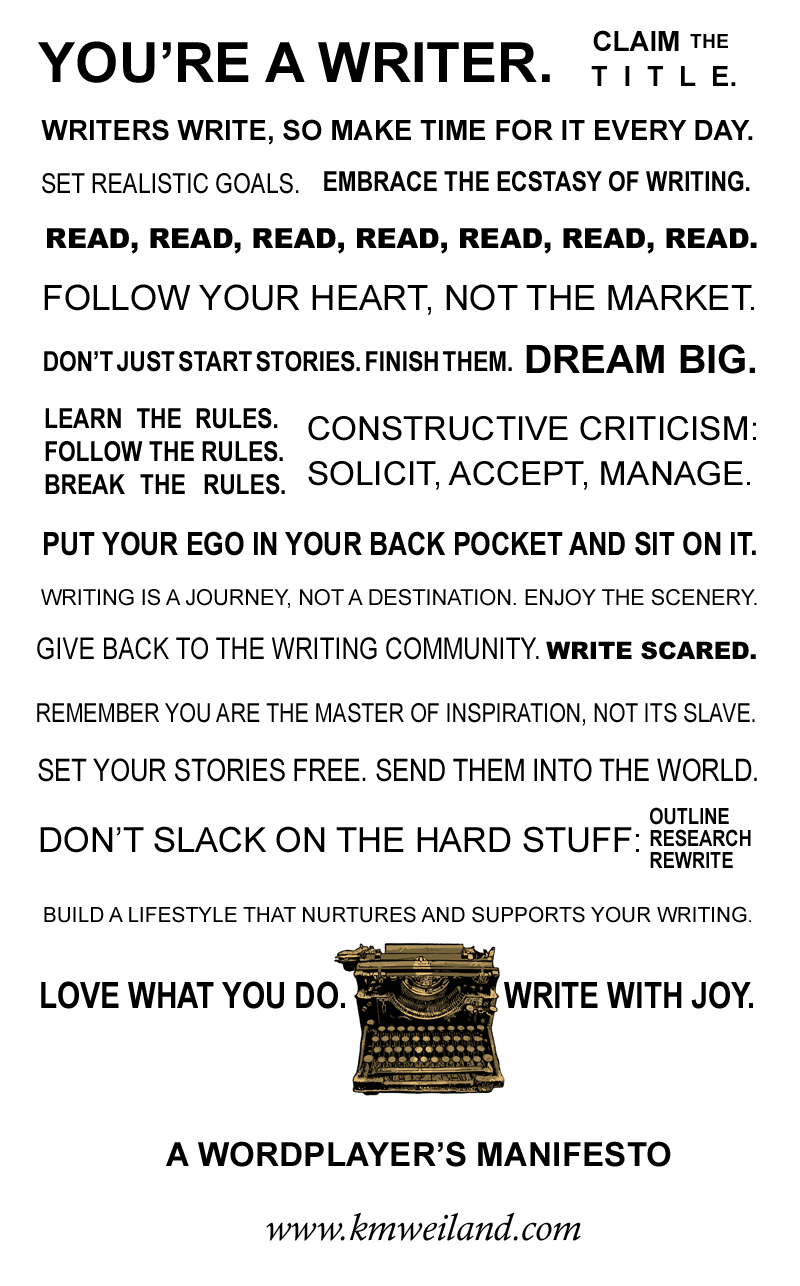
A Wordplayer’s Manifesto

While following the links on K.M. Weiland’s resource page at her website Helping Writers Become Authors, I found A Wordplayer’s Manifesto that I wanted to share, below.

K.M. Weiland is the published author of three novels and two how-to writing books. She mentors writers through her blog, vlog, and nonfiction books. You might want to check out her Recommended Reading for Writers and excellent Podcast Episodes. And if you sign up for her newsletter, you’ll get a free copy of the eBook Crafting Unforgettable Characters.

Manifesto-800