Writing a Memoir Like a Novel: Six Elements of Fiction

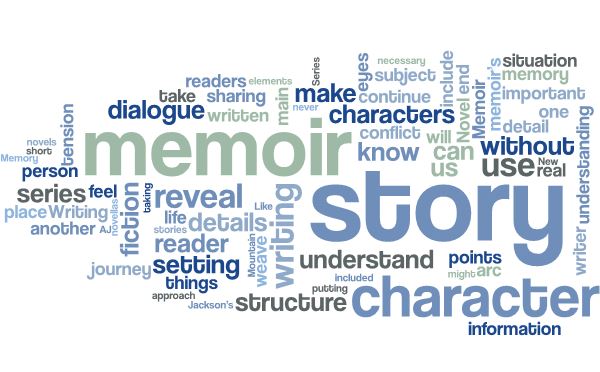
Novel Memoir Series Word CloudIn my ongoing series, Writing a Memoir like a Novel, I share what I know about writing fiction as it applies to memoir. I hadn’t tried my hand at a memoir until I took on the project that became This New Mountain, but I have written short stories, novellas and novels. You might understand, then, why my approach to writing AJ Jackson’s true story (of a feisty private detective and grandmother) included the elements that make up a work of fiction.

If you’d like your memoir to have the depth and flow of a novel, try adding fictional elements — and check out my posts about crafting characters, setting, dialogue, a compelling opening, point of view, and story arc. Here are the summaries of the six articles in the series so far:

Characters

Apply fiction techniques to your “built-in” characters to bring your story, and the real-life people who inhabit it, to life. Physical description doesn’t tell us who a person is — we understand others by their actions and the choices they make. Weave in details a little at a time to reveal the characters as the story unfolds. By sharing the story behind the story, the reader gains an understanding of the why of things. Show how a person deals with change to shed light on that person’s character. Reveal the familiar, those common things we all relate to, to get the reader emotionally involved. Other details, such as relationships, ambition, and personal flaws, add layers and reveal character.

Setting

Creating memorable settings – without unnecessary detail – strengthens the writing and draws the reader into the story. Present the setting through the eyes of your character. Determine why a particular place is important to the character and how she feels about it. Use historical research to take you beyond the limits of your own memory. Make your story immediate and real to the reader by using just enough sensory detail.

Dialogue

Dialogue can reveal motives, character, conflict, setting, and important information, and can create tension, suspense, and movement through scenes. While staying true to your memory, produce realistic dialogue by following certain conventions: use contractions; don’t overuse names; avoid niceties and information dumps; use dialect and vernacular sparingly; beware exclamation points (!!!); structure paragraphs and use tags/beats to make it clear who is speaking.

A Compelling Opening

Memoir readers don’t expect action-packed openings, but the first few pages should still compel us to continue on and immerse ourselves in the story. A good opening will include: a character we know and understand; a situation that presents tension; an indication of the larger story problem or conflict; the general tone of the story (such as light-hearted or serious).

Point of View

Take readers to a place where they feel what you felt without telling them how to feel. Write an “eye memoir” versus an “I memoir.” Step back from who you are now as the writer and return to the perspective of who you were during the period of your memoir. In the end, your memoir is less about what happened and more about the importance of your journey, what you brought into it and how the journey changed you.

Story Arc

A story arc moves the main character (you or the subject of the memoir) from one situation to another, one state of being to another. Without this structure and focus, the memoir becomes a disconnected, chaotic jumble. Knowing and understanding your story arc – the beginning-middle-end structure – keeps the writer focused on what the memoir is about and acts as a guide to know what to include and what to leave out, as well as what needs detailing and what can be touched on through summary.

In the months ahead, I’ll be posting more in the Writing a Memoir Like a Novel series to include pacing, scene structure, and passive voice.

If there is a specific topic you’d like me to address in a future post, please leave a comment.

With Freedom Comes Creativity

Image

It’s Not Too Late to Enjoy Christmas

Busy, busy, busy. I’ve pulled a post from my archives because I just can’t seem to learn from years of experience that December is a crazy month, and I really should plan better.

A Winter Tree w/Red BowsI’ve been getting up early and going to bed late, rushing here and there, trying to finish everything necessary to make this a great Christmas. I overextended myself in November, so I’m a month behind on everything including making crafts, baking cookies, decorating the tree and the house, and shipping off packages still waiting to be filled with gifts. Not to mention the Christmas cards that need personalized notes (plus addressing and mailing out). I even had to cancel my volunteer day this week – just no time. I am, in fact, doing exactly what I promised myself I would not do again this year.

I wanted this Christmastime to be less stressful and more joy-filled than previous years. To follow a plan, check things off lists, and put my feet up the week before the red-suited plump guy slides down the chimney, and sigh contentedly that life is good.

Today, in the middle of all this craziness – and my broken dream of a perfectly planned and executed holiday – I remembered why I like Christmas. It’s not dragging out the decorations and the lights, or the annual five-pound weight gain, or the hours of shopping and stressing over the right gift. But I love the twinkling lights that make the world glow like a fairyland. I love sharing and eating holiday goodies. And I love giving gifts and celebrating the reason for the season: the birth of Jesus. All these things, plus the feeling that everyone seems jollier this time of year, add up to why I like Christmas so much.

There’s one more thing I remembered today. Life is good. Very good, despite the self-imposed craziness. I’m blessed beyond measure. I have a loving husband and children, friends who care about me, a soft bed and a warm house, and plenty to eat. And too many more blessings to count.

To uncrazify my days, I need to keep reminding myself that Christmas isn’t what makes me rush around trying to get things done – it’s my own expectations and what I think others expect from me.

I can still enjoy Christmas if I let go of a few things on my unfinished to-do list. If I slow down and focus on what I want the next twelve days of December to be like, I will have the best gifts anyone can ask for, or give – joy and peace, and time spent with friends and family.

How are you handling holiday stress?

Wisdom from Winnie-the-Pooh

Image

Free Resources for Writers: Writing and Editing

Word Cloud Free Resources2Writers have countless ways to spend their money — whether on a double espresso to push through a final draft or a conference that has called to us for years. We all have life expenses that we must spend our money on now, as well as more wishful things that require time and sacrifice to save up for.

Here are a few free and useful resources to help you save money while still being able to organize, edit, and shape your writing world and its characters.

 Organizing Tool

yWriter5 is free novel-writing Spacejock software (designed for Windows PCs) that helps a writer organize and keep track of scenes and chapters, characters, settings and plot elements. “It will not write your novel for you, suggest plot ideas, or perform creative tasks of any kind. It does help you keep track of your work, leaving your mind free to create.” The program was designed by Simon Haynes, programmer and author, after he struggled to keep track of the elements in his own first novel. You can type directly into yWriter5 or use your own word processor and then use yWriter5 to keep track of scenes, etc. Features include: tracking your progress; automatic backups at user-specified intervals; adding multiple/viewpoint characters, goals, conflict and outcome fields for each scene; a storyboard view for a visual layout of your work; re-ordering of scenes, drag and drop elements. “Contains no adverts, unwanted web toolbars, desktop search programs or other cruft.” K.M. Weiland has a yWriter video tutorial on her website here.

Editing Tools

  • ProWritingAid is a free online writing editor. Paste in a chapter and it produces 19 free reports to improve your writing – checks grammar and spelling; finds overused/repeated words and phrases, and clichés; checks for consistency in spelling, hyphenation and capitalization; analyses your manuscript for alliteration, vague/abstract/complex words, passive voice and adverbs, sentence length, and dialogue tags. One of the things I enjoy most about ProWritingAid is the feature that creates a word cloud – a visual representation of the most often used words in your text. For an example, see the word cloud for this article at the top of the post.
  • Listening to your work read aloud is a good way to catch mistakes and missing words, and also hear how it all flows. NaturalReader is free text-to-speech software with natural sounding voices. This software can read any text from Microsoft Word files, webpages, and PDF files (and can also convert text into audio files such as MP3 or WAV).

Writing Tools: Thesauruses

There are plenty of online thesauruses that provide alternate word choices, but nothing as extensive as what I found on the Writers Helping Writers website with its collection of free resources.

If you “need help describing your character’s pain, exhaustion, illness, dehydration, hunger, stress, attraction and more” download Emotion Amplifiers (a companion to The Emotion Thesaurus by Angela Ackerman & Becca Puglisi). This is a free 33-page pdf that “supplies the body language, thoughts and internal sensations that accompany conditions that ‘amplify’ a character’s mental state, leading to a stronger emotional reaction.” Go to the Writing Tools page (with lots of other free stuff) or click here for a direct link to the Emotion Amplifiers download.

You’ll find eight more Thesaurus Collections at the Writers Helping Writers website to help in describing every sort of thing writers might include in their fiction or nonfiction writing:

  • Physical Attributes Thesaurus Collection – choose specific physical features to create compelling and memorable characters
  • Weather & Earthly Phenomena Thesaurus Collection – for emotion-targeted sensory description
  • Color, Textures and Shapes Thesaurus Collection – add descriptive layers; create simile or metaphor for different shapes, colors and textures
  • Character Traits Thesaurus Collection (Samples) – cardinal personality profiles (expanded in The Positive Thesaurus & The Negative Thesaurus books)
  • Setting Thesaurus Entry Collection – smells, sights, tastes, sounds and textures for over 100 different fictional settings
  • Symbolism Thesaurus Entry Collection – use iconic symbolism for different literary themes (the passage of time, coming of age, etc.)
  • The Talents and Skills Thesaurus Collection – skills or talents make characters authentic, unique and interesting.
  • Emotion Thesaurus Entry Collection (Samples) – avoid overused expressions (like frowns and shrugs); craft unique body language, etc. (expanded in the comprehensive Emotion Thesaurus resource)

What are your favorite free writing and editing resources?

Keep Searching

Image